18.09.2026
Alithea Bio Featured in Nature Biotechnology’s Dark Proteome Report
18.09.2026
16.09.2026
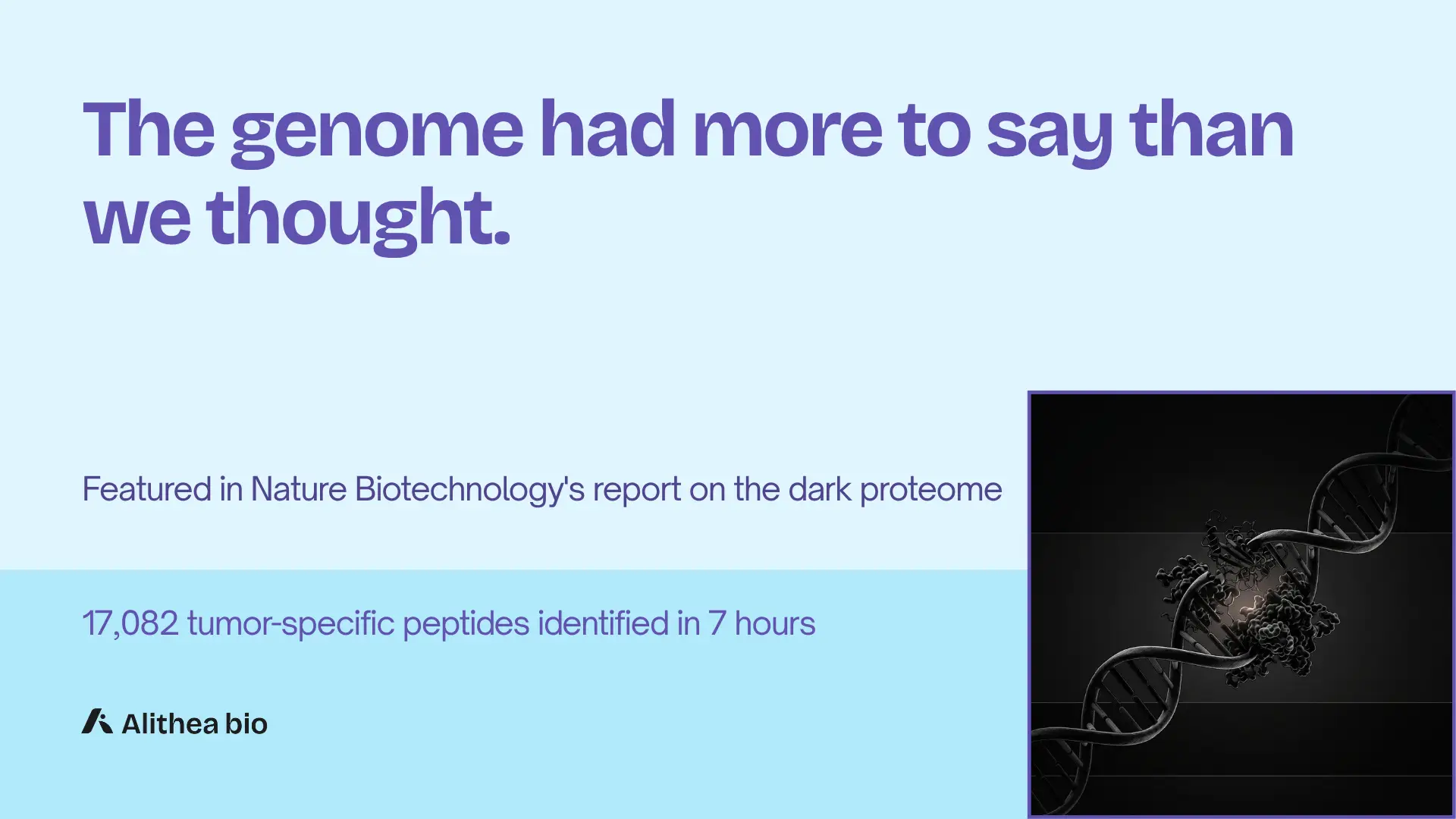
Alithea Bio has been featured in Nature Biotechnology‘s September 2026 news feature on the “dark proteome” — the fast-growing field of previously undiscovered proteins now being explored as new drug targets. Here’s what the feature covers, and how our own work fits into the story.
The feature, titled “Startups mine ‘dark proteome’ for new drug targets,” reports on a growing wave of biotech companies searching the previously overlooked regions of the human genome for viable drug targets. For decades, the genome was assumed to encode roughly 20,000 proteins, based on rules established during the Human Genome Project. That number is turning out to be a serious undercount — thousands of additional protein-like molecules are now being identified in regions once dismissed as non-coding, many of them active specifically in cancer cells.
The article profiles several companies working across this space — including Alithea Bio — alongside a broader industry shift toward the “translatome,” and notes a wave of pharmaceutical partnerships already forming around dark proteome targets with companies including GSK, Pfizer, Novartis, Merck, Eli Lilly, and Boehringer Ingelheim.
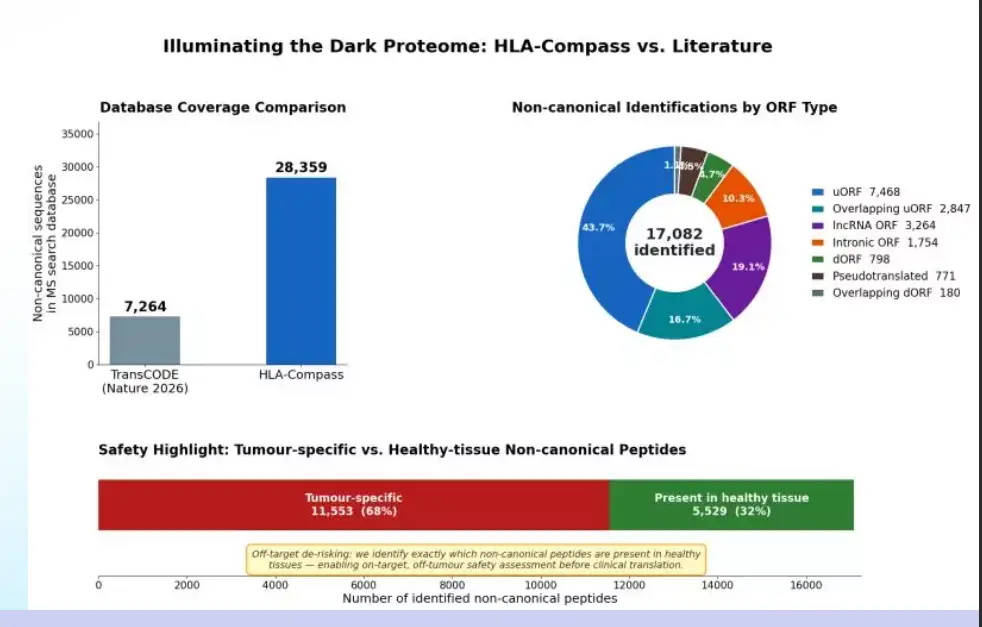
Much of the recent momentum behind this field connects to work published by the TransCODE Consortium, whose Nature paper earlier this year has been an important reference point for our own analysis. Their published catalogue of non-canonical open reading frames gave us the foundation to ask a very practical question: what happens when you search real-world immunopeptidomics data against it?
When the latest non-canonical ORF catalogue was published, our team didn’t just read about it. Instead, we searched the world’s largest HLA peptide database against it, and discovered 17,082 non-canonical peptides in 7 hours. Most strikingly, 11,553 of those dark proteome peptides were tumor-specific.
We also expanded HLA-Compass with HERV-derived sequences, which are remnants of ancient viral DNA left embedded in the human genome over millions of years. From 4,800 samples, we identified 34,955 unique peptides. Crucially, those peptides were not exclusively tumor-associated. Many appeared in healthy tissues too, which is a critical consideration for anyone developing therapies in this space.
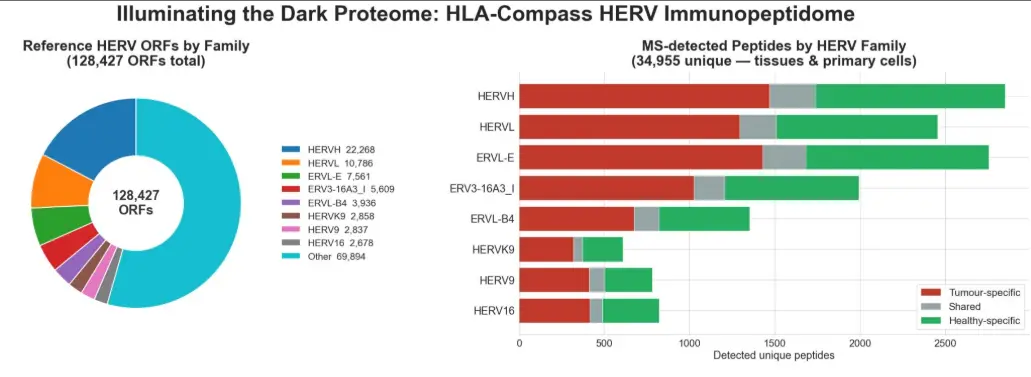
Together, these two analyses illustrate a simple but important point: the more dimensions we add to the searchable immunopeptidome — non-canonical ORFs, HERV-derived sequences, and beyond — the more powerful target discovery becomes. But that same expansion makes rigorous healthy-tissue profiling non-negotiable. A tumor-associated candidate that also appears in healthy tissue is a very different therapeutic proposition than one that’s genuinely tumor-exclusive, and only large-scale, quantitative comparison across real-world samples can tell the two apart.
This is the space HLA-Compass AI was built for: not just discovering candidates in the dark proteome, but rapidly validating where else in the body they show up.
The dark proteome refers to proteins and peptides encoded by regions of the genome historically considered non-coding — including non-canonical open reading frames (ncORFs) and endogenous retroviral sequences — that fall outside the roughly 20,000 canonical protein-coding genes.
Alithea Bio is one of several companies profiled in the feature for its work using mass-spectrometry-based immunopeptidomics to identify which dark proteome candidates are actually presented to the immune system — a critical step in turning a newly discovered protein into a viable drug target.
The ORF analysis searched HLA-Compass against a catalogue of non-canonical ORFs drawn from recently published research. The HERV work is a separate expansion into peptides derived from ancient retroviral DNA embedded in the human genome — a related but distinct category within the broader dark proteome.
Want to learn more about how HLA-Compass AI can help validate dark proteome candidates for your own program?
Related reading: Dark Proteome Unlocked: HLA-Compass AI Finds 17,082 Cancer Targets | HLA Presented Peptides | Neoantigens | Immunopeptidomics Technology