Products
HLA peptides binding predictions
HLA binding prediction for 127 HLA-A, -B and -C alleles
HLA Binding Prediction Trained on Mass Spectrometry Data
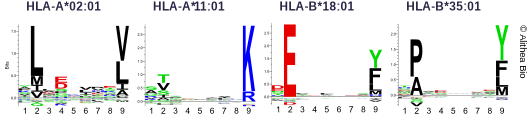
Alithea’s predictors are more accurate than those based on e.g. IEDB data because of the large dataset behind HLA-Compass. For example, HLA-Compass contains over 55k unique HLA A*02:01 peptides whereas IEDB includes around half of the total number of sequences. Especially for rare alleles (e.g. C*15:02 below) the number of peptides in HLA Compass is significantly higher than in IEDB or in monoallelic cell line data publicly available.
How HLA-Compass Peptides Are Annotated to HLA Alleles
Any HLA peptide present in HLA Compass is annotated to its cognate HLA allele through the binding predictors that Alithea has developed. The peptide is submitted to binding prediction against all HLA alleles of a given sample and then annotated to the one for which the prediction results are best (i.e. most likely to be eluted from the specific HLA allele). Within HLA Compass, this is termed “Best predicted binder”.
Contact us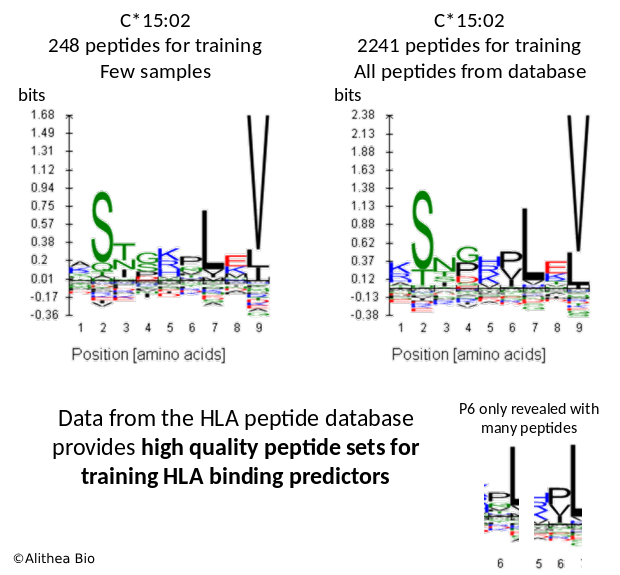
What Is HLA Binding Prediction?
HLA binding prediction estimates how likely a peptide sequence is to be bound and presented by a particular HLA allele. It is the first filter in nearly every T cell epitope, neoantigen or immunogenicity project: a tumour exome or a therapeutic protein can yield thousands of candidate peptides, and only a small fraction of them ever reach the cell surface.
The quality of that filter decides how much laboratory work is spent on the wrong candidates. A predictor that ranks poorly sends a project after peptides that are never presented; a predictor trained on the right data concentrates the real epitopes at the top of the list, where the budget for validation actually goes.
Trained on Eluted Peptides, Not Affinity Assays
Many publicly available predictors are built largely on in vitro binding affinity measurements. Affinity is only one step of antigen presentation: a peptide also has to be generated by the proteasome, transported into the ER and loaded onto an HLA molecule before it appears on the cell surface.
Alithea’s predictors are trained on HLA peptides that were eluted from cells and identified by mass spectrometry, collected in HLA-Compass. Because every training example is an observed presentation event, the models learn the combined rules that decide what is displayed, rather than binding strength alone.
Which HLA Alleles Are Covered?
The predictors currently cover 127 HLA class I alleles: 47 HLA-A, 57 HLA-B and 23 HLA-C. Together these account for more than 97% of the HLA alleles carried by the German population, so most donor or patient cohorts can be analysed allele by allele instead of relying on a pan-allele approximation.
HLA-C is where the difference from public resources is usually largest. C alleles are expressed at lower levels and are under-represented in public datasets, so the peptide evidence behind them is thin. For rare alleles such as C*15:02, HLA-Compass holds considerably more peptides than IEDB or the monoallelic cell line data available publicly.
How Peptides Are Assigned to an Allele
A sample from a donor or patient expresses up to six HLA class I alleles at the same time, so an eluted peptide has to be attributed to the allele that most likely presented it. Each peptide in HLA-Compass is scored against every allele present in its sample and assigned to the best scoring one, recorded in the database as the best predicted binder.
This keeps the database allele-resolved rather than sample-resolved, which is what makes it usable both for immunopeptidomics analysis and as training data for the next generation of predictors.
Where Binding Prediction Fits in a Project
Prediction narrows a list; mass spectrometry confirms it. In a neoantigen programme, variant calling produces candidate sequences, binding prediction ranks them against the patient’s own alleles, and targeted detection with NeoZOOM establishes whether the prioritised peptides are genuinely presented. The same logic runs through neoantigen discovery and proteogenomics projects.
Beyond Cancer Vaccines
The same ranking step appears outside oncology. For protein therapeutics, prediction highlights sequences within a biologic that are likely to be presented and to drive anti-drug antibodies. For off-target toxicity prediction, it flags peptides in healthy tissue that resemble the target of a TCR or TCR-mimic, so that risky cross-reactivity is found before the clinic rather than in it.
Frequently Asked Questions
How is this different from NetMHCpan?
The modelling task is the same, but the training data is not. The predictors are built on peptides eluted and measured in-house across a large allele panel, which gives denser evidence for alleles that are sparsely covered in public repositories.
Which peptide lengths are supported?
Class I presentation is dominated by 8 to 11-mers, and that is the range the models are built around. Longer candidate sequences are handled by scoring their constituent peptides.
Do I need my own mass spectrometry data?
No. Prediction only needs the peptide sequences and the HLA type of the sample. Mass spectrometry becomes relevant when you want to confirm the prioritised candidates experimentally.
Working With the Predictions
What if my allele is not in the panel?
The panel covers 127 class I alleles. If a cohort carries an allele outside it, we can discuss whether existing data supports adding it, often alongside an immunopeptidomics study on relevant samples.
Are HLA class II peptides covered?
The predictors described here are class I. Class II presentation is handled through dedicated immunopeptidomics work rather than this panel.
How do I get access?
Binding predictions are available through HLA-Compass and as part of discovery projects. Contact us with your alleles and candidate list and we will advise on the right route.