Episode 3
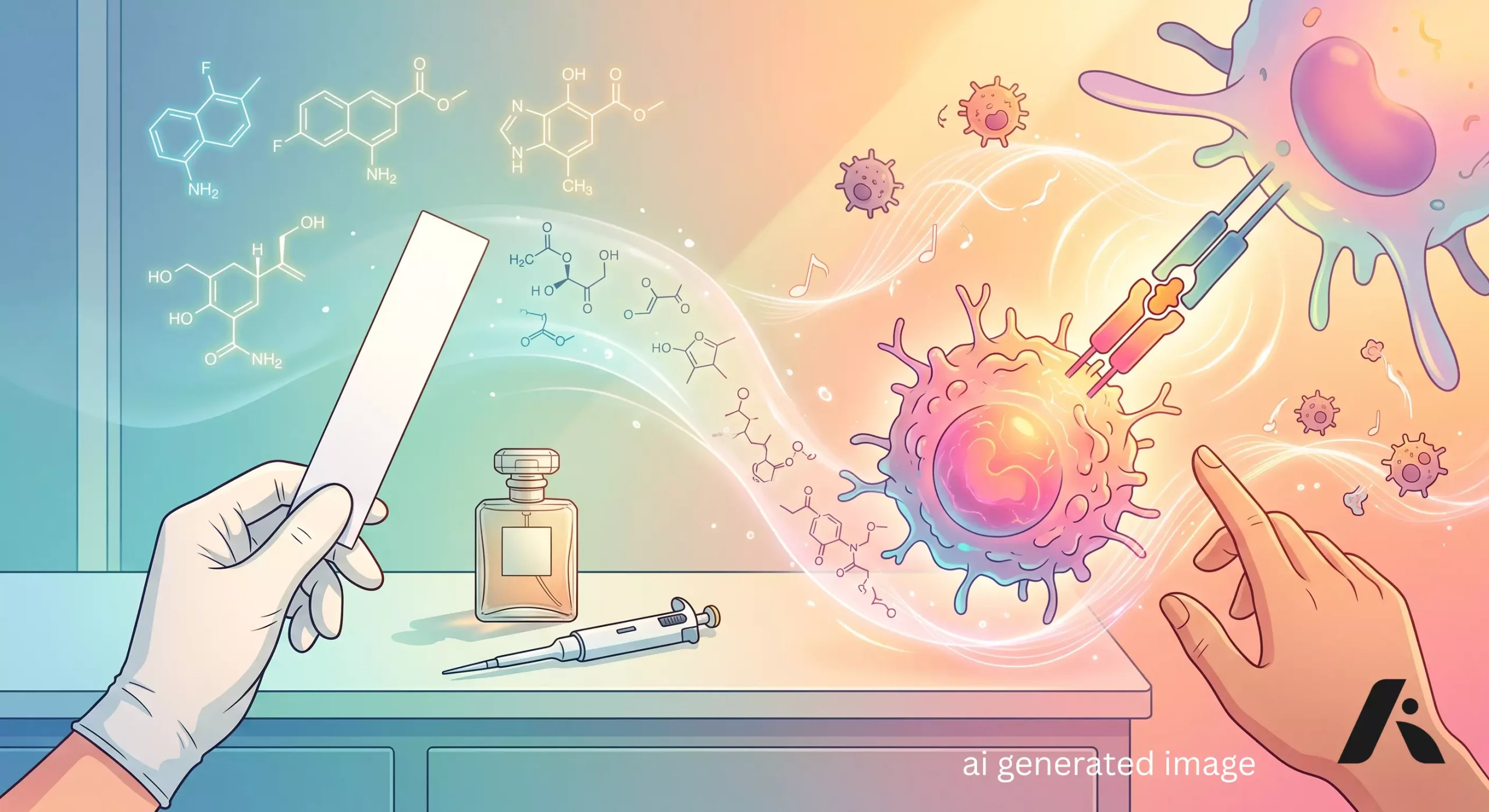
What do cancer therapies and perfumes have in common?
The first line of any written word should probably not be a disappointing one, but we will have to disappoint you anyways. You cannot cure cancer with perfumes – but if anyone has an idea how, we are happy to listen. Also, there are arguably not many similarities between cancer therapies and perfumes. End of the article. Thank you for reading.
If you would like to bear with us though, there is something perfumers understood before immunologists did. Somewhere on the shelves, there is a book that has nothing to do with immunology, but everything to do with perfumes, or more specifically smell. Luca Turin in his The Secret of Scent asks how a smell receptor knows what it has just bound.
If you didn’t know, the 2004 Nobel prize was awarded to Linda Buck and Richard Axel for mapping the receptor family that “smells” an odorant in their receptor pockets, which in return triggers signals, and we get to smell flowers, sea air, fresh fruits, and sweaty armpits in public transportation. Turin doesn’t argue with the concept, but it does flag it as incomplete. Why? Because molecules with almost identical shapes can smell entirely different, whereas molecules with quite different shapes can smell nearly the same. For example, anything with a sulphur-hydrogen bond smells of rotten eggs, almost regardless of the rest of the molecule. He proposed that olfactory receptors do not only “smell” a molecule’s shape, but they feel its vibrations. Sounds cool? Absolutely! Is it true? No. Although Turin’s experiments initially offered some merit to the proposed mechanism, and it seemed like he was on the right track, his theory was unfortunately rebutted. The mechanism is probably wrong. Turin’s question, though, was excellent and transferable.
Following this train of thought, all of you immunologists out there probably know the textbook answer on what does a T cell receptor (TCR) actually “smell”. It is quite a romantic story. Evil outsiders invade our cells, our cells present pieces (called peptides) of the evil outsiders in their human leukocyte antigen (HLA) groove, which then signals the brave knights, T cells, that our organism is under attack. The brave T cells with the correct TCRs recognize the invaded cells, destroy them, and save the kingdom. And everyone lived happily ever after. Until the next time you sleep under air conditioning. This is still true, but it is not enough to reliably infer peptides from TCR sequences or vice versa. Since we rely on TCRs to protect us from external, but also internal (e.g. cancer) threats, they need to be extremely diverse to respond to roughly a quadrillion different peptide-HLA complexes. Since the human repertoire is estimated to have fewer than a hundred million unique TCRs, it means that TCRs have to be substantially degenerate. On the other hand, some TCRs can be incredibly discriminating. For example, swapping one amino acid in a peptide can abolish recognition or create it. This is utilized in developing cancer therapies against cancer specific mutated peptides. Recent benchmarking of machine learning predictors by Vandoren et al. (2026) found that they underperform on peptides not seen during training, including those single amino acid variants of well-represented peptides. Coming back to the romantic story, we can reasonably well predict which peptides will fit into the HLA groove, but which of them will be seen by the TCRs of the brave T cell knights still remains a question. There is something missing in this structural picture. Turin’s instinct that there is a layer beneath shape is a good instinct to have here.
Although I would be happy to report that TCRs are reading, or smelling, peptide vibrations, they are almost certainly not. There are, however, well-described additional layers to be taken into the account: dynamics (e.g. Ma et al., 2025), mechanics (e.g. Wu et al., 2019), and flexibility (e.g. Tomasiak et al., 2022). So, yes, there seems to be more to recognition than just structure. It is conformational and mechanical rather than vibrational, but conceptually, Turin was right: we should add dimensions rather than trimming the observations to fit our models.
Between perfumery and immunology, the parallel is in the architecture. Humans have roughly 400 olfactory receptors. One receptor responds to many odorants, and one odorant may activate many receptors. The identity of a smell lies in the pattern instead of a single interaction. This allows us to cover a big chemical space with a small number of detectors. In immunology as well, TCR degeneracy is not a design flaw, but a solution that makes the coverage possible. The two fields share another similarity. Of the 400 human olfactory receptors, only around 10% have a published ligand. Likewise, the majority of sequenced TCRs have no known epitope, and a majority of published epitopes, especially in cancer and autoimmune conditions, lack known or efficacious TCRs. And both have learned their lessons about prediction. No perfumer will compose from a structure file. They rely on smell, because how a molecule behaves on skin or in a mixture, is not reliably predictable from what it looks like on paper. If TCR specificity cannot yet be predicted from the sequence, then the ground truth needs to be measured.
And that is where immunopeptidomics comes in. Immunopeptidomics tell us what a tumor, for example, does present instead of what it could present according to a binding predictor. It reveals the actual notes on the cell surface, measured by mass spectrometry, in tumor tissues, healthy organs, and in many other immune-mediated conditions. We built a reference library of real presentation, rather than a menu of possible candidates. One last fragrant analogy for the road. The off-target problem. A perfume can be perfect on the blotter, and completely wrong on the skin. Maybe also not on all skin, but only in some individuals. A target can look tumor-specific in transcriptomic data and turn out to be lurking in cardiac tissue in individuals with specific HLA types. We can find that out only by measuring healthy tissue instead of modelling based on only a part of a picture. We are, in the end, not arguing against predictions, but about what predictions should be trained on. Which is the whole idea behind what we build. Our immunopeptidomics services do the measuring, HLA-Compass is our library of the measurements, and FindingNEO is a predictor trained on that evidence instead of binding alone. That is why a neoantigen is five times more likely to be immunogenic when its wild-type counterpart has actually been seen in the immunopeptidome. We still cannot predict what a specific T cell smells, but we are increasingly more confident in saying what there is to be smelled.